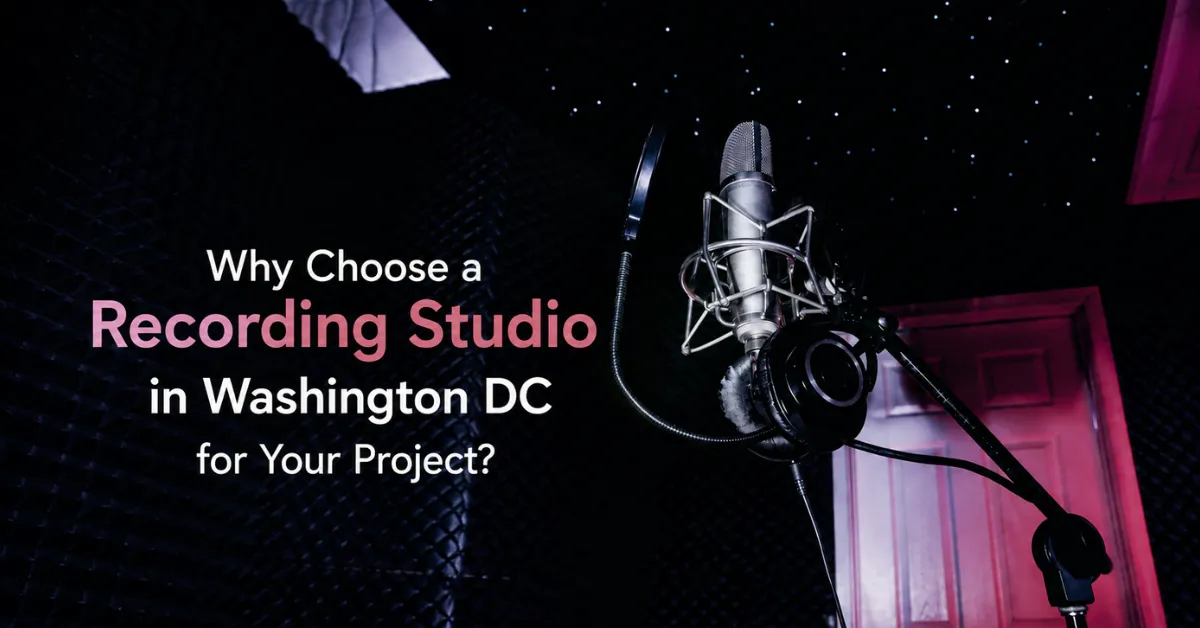
Why Choose a Recording Studio in Washington DC for Your Project?
Home recording got good. Really good. An interface, a decent condenser, and a laptop will get you further than a full commercial setup could twenty years ago. So the fair question is why anyone still books a recording studio in Washington DC when the barrier to entry has basically disappeared. The answer isn't nostalgia and it isn't gear snobbery. It comes down to what happens to a track between the moment you sing it and the moment somebody streams it, and how much of that you want to be responsible for yourself.
What You're Actually Paying For
Rooms that were built, not converted
The single biggest difference between a professional space and a home setup is the room. A treated live room and vocal booth are designed to control reflections, isolate sound, and give the engineer a predictable starting point. That's construction work: framing, insulation, floating floors, non-parallel surfaces, and absorption placed where it does the most good.
You can improve a bedroom with foam and blankets. You cannot make it behave like a purpose-built booth, because the physics of the space are fixed. This matters most on vocals, where every reflection lands directly on the take you're going to build the whole song around. A dedicated space for tracking and recording removes a variable you'd otherwise be fighting through the entire mix.
Signal chains that stay consistent
Professional studios run the same microphones through the same preamps into the same converters every time. That consistency sounds boring until you try to record a follow-up verse three weeks later at home and can't remember your gain setting, your mic position, or which corner of the room you stood in. Studio sessions are repeatable. Home sessions usually aren't.
There's also the matter of range. A studio has multiple microphones because different voices need different characters. A bright vocalist and a dark one shouldn't be on the same mic, and having options is the difference between chasing a sound in post and capturing it correctly the first time.

Why a Recording Studio in Washington DC Makes Sense for Local Artists
Access and logistics
DC is dense, transit-connected, and full of people making things. A studio in the city means your engineer, your producer, your featured artist, and your videographer can all get to the same place without anyone driving ninety minutes. That sounds like a small thing. It isn't. Sessions fall apart over logistics more often than they fall apart over creative differences.
Being local also means you can come back. Records rarely finish in one visit. A studio twenty minutes away gets revisited. A studio in another state gets one session and then a lot of emailed files.
Practical things to check before you book
Is parking available, or is the space near a Metro station?
How late can sessions run, and are there noise restrictions?
Is there a lounge or waiting area for people who aren't tracking?
Does the rate include an engineer, or is that separate?
Can you tour the room before committing to a block of hours?
The people in the building
Gear is buyable. Experience isn't. An engineer who has tracked hundreds of artists knows how to get a nervous vocalist to relax, when to push for another take, and when the fifth take was worse than the second. A producer in the room can hear that your hook needs to arrive eight bars earlier.
That accumulated judgment is most of what separates a good session from an expensive one. Studios that have grown out of a local scene tend to carry that context with them, and reading through how a studio came together usually tells you more about its culture than a gear list ever will.
The Difference Between Recording and Finishing a Record
A lot of independent artists stall at the same place. The recording is done. It sounds fine in headphones. Then it goes on a car stereo and the vocal disappears, or the low end turns to mush, or it's noticeably quieter than every other song in the playlist.
Where mixing and mastering fits
Mixing is the process of balancing every element so the song works as a whole: levels, panning, EQ, compression, effects, automation. Mastering is the final pass that makes the finished mix translate across phone speakers, car systems, club rigs, and streaming platforms at a competitive loudness.
Both are separate skills from recording, and both are genuinely difficult to do on your own material because you stop hearing it objectively after the fortieth listen. Handing a project to someone who does mixing and mastering daily is often the single highest-return decision an independent artist makes. It's also the step people skip most often, which is why so many self-released tracks sound almost right.
What Kinds of Projects Belong in a Studio
Not every project needs one, and it's worth being honest about that. A rough demo to send a collaborator does not require a booked room. Neither does a voice memo of a melody idea before you forget it.
What does belong in a studio: anything you plan to release commercially, anything with multiple performers who need to be recorded well simultaneously, anything with a video component, and anything where you need a result by a specific date. Studios also handle full beat and track production when you're starting from an idea rather than a finished instrumental, which shortens the path from concept to release considerably.
Podcasts, voiceover work, and audiobook narration land in the same category. Spoken word is unforgiving. Room noise that hides underneath a dense instrumental sits right out in the open on a bare voice, and a refrigerator hum you never noticed while tracking becomes the only thing you hear on playback. Commercial clients and publishers also tend to have technical delivery specs, and meeting those consistently is much easier from a room that was built for it.
How to Get the Most Out of Your Session
Come prepared. Know your lyrics, know your arrangement, and have a reference track that sounds like where you want to end up. Warm up before you arrive rather than burning the first paid hour finding your voice.
Book realistically. Two hours is enough for one vocal on an existing instrumental if you're rehearsed. It is not enough to write, record, and mix a song. And bring fewer people than you want to. Studios get crowded fast, and every extra person in the room is another opinion slowing down decisions.
The teams at spaces like HighLife Studios will tell you upfront how much time your project actually needs, and any studio that books you for less than the job requires is doing you a disservice.
If you're weighing it up, the fastest way to decide is to walk into the room, hear how it sounds, and ask what a session for your specific project would look like. Most studios will talk it through with you before you spend a dollar.
