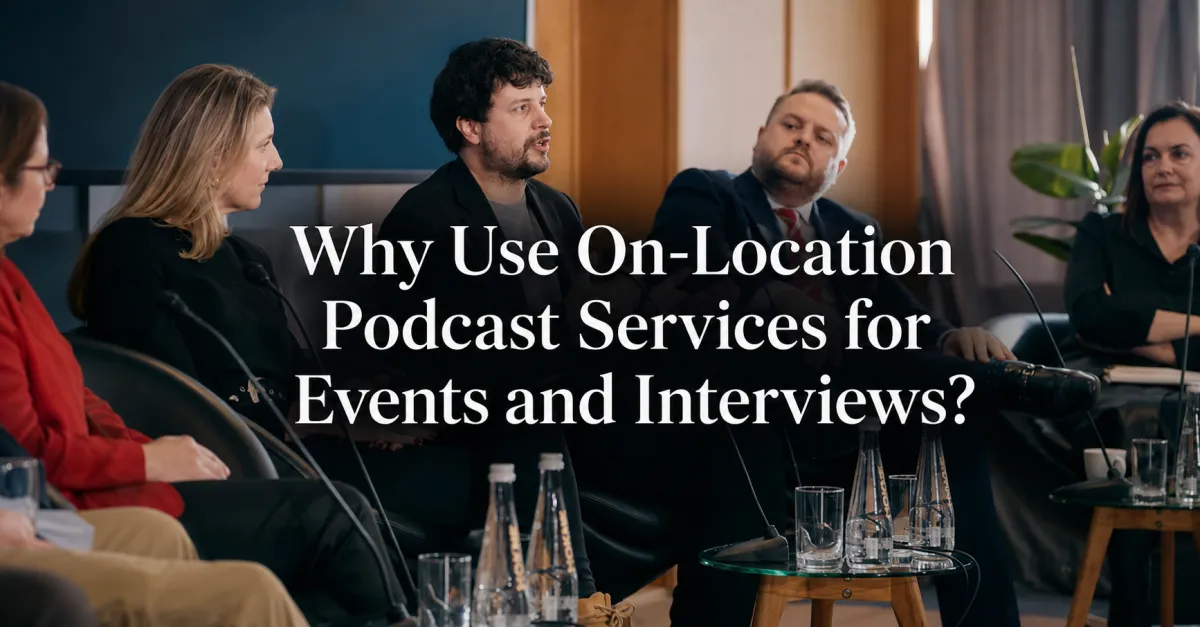
Why Use On-Location Podcast Services for Events and Interviews?
Some conversations only happen once. A founder walking off stage after a keynote, a guest who flew in for a single afternoon, a room full of people who will never all be in the same city again.
Trying to move those moments into a booth usually means losing them entirely. That is where on-location podcast services earn their keep.
Instead of asking everyone to come to you, a crew brings the cameras, microphones, lighting, and technical judgment to wherever the story already is.
You get professional audio and video without asking a single person to rearrange their day.
What On-Location Podcast Services Actually Cover
There is a wide gap between someone showing up with a handheld recorder and a full production team setting up in your space.
A proper on-location session can involve producers, audio engineers, camera operators, lighting, multiple recording paths, and a technical plan built around the room you actually have.
The space may need to be checked for HVAC noise, buzzing lights, hard reflective surfaces, guest movement, and power access before recording even begins.
A Full Crew, Not a Drop-Off Kit
Rental gear is only as useful as the person operating it. If a microphone starts crackling in the middle of an interview, somebody has to catch it immediately and move to a backup path.
HighLife Studios already provides professional recording and podcast production services supported by engineers and producers, making that technical experience especially important when the recording environment becomes less predictable.
Gear Built for Unpredictable Rooms
Portable cameras, microphones, lighting, redundant recorders, and careful cable management can turn a difficult event space into a workable production environment.
The important part is not simply bringing more equipment. It is choosing and positioning the equipment around the room you actually have.
Explore HighLife Podcast Production
See how professional recording, editing, and production can help turn a conversation into polished podcast content.
Explore Podcast Services →Why Events Are Worth Recording on Site
Conferences, launches, festivals, and community gatherings concentrate people who may be difficult to book individually.
Every attendee list can become a guest list you did not have to build from scratch.
Access You Cannot Recreate Later
Event podcast recording lets you capture several guests during the same production day.
Trying to schedule those same conversations separately can mean months of emails, cancellations, travel, and rescheduling.
Panels and Keynotes
Stage content already has structure. When the production team can capture a clean feed and combine it with dedicated camera angles, one session can produce long-form material plus shorter clips.
Hallway Interviews
Some of the strongest conversations happen immediately after a session, when the speaker or attendee is still reacting to what just happened.
That immediacy is difficult to recreate three weeks later on a remote call.
Energy That Translates to the Audience
A real environment creates visual and sonic context. The goal is not to eliminate every trace of the room, but to control the environment enough that the energy feels intentional rather than distracting.
Give Your Final Episodes a Professional Mix
HighLife's mixing and mastering services are designed to turn raw recordings into cleaner, more polished final audio.
Explore Mixing & Mastering →Interviews That Work Better on the Guest's Turf
Executives, doctors, artists, public figures, and other high-demand guests often have limited calendars.
Asking them to travel to a studio can become the exact reason an interview never happens.
Going to their office, venue, workshop, or event solves the scheduling problem and can create a more natural visual environment.
HighLife Studios operates as a full-service recording and production studio with professional engineers and producers across its creative spaces.
Use the Environment as Part of the Story
An office, gallery, workshop, venue, or backstage area can contribute context that a generic studio wall cannot.
Recording on location also creates opportunities for supporting footage. While the crew is already there, B-roll can give editors more options during longer answers and transitions.
What to Look for in an On-Location Podcast Team
Not every studio travels well. Field production adds variables that do not exist inside a controlled recording room.
Sound-First Thinking
Audio deserves attention before recording starts. Ask how the production team would approach HVAC noise, reflective walls, crowd noise, and other environmental problems.
Careful mixing and mastering can improve recorded material substantially, but it works best when the original signals were captured cleanly. HighLife currently offers both collaborative in-studio mixing and remote mixing/mastering services.
Backup Recording Paths
Redundancy matters. Batteries fail, cards can have issues, and cables can get moved during busy events.
Ask how the crew protects important recordings when a single point of failure appears.
Post-Production Under One Roof
Keeping recording and post-production connected can simplify the process because the same team already understands the environment, the speakers, and the strongest moments captured during the day.
HighLife's broader service offering includes recording, podcast production, mixing/mastering, and creative production support.
Clear Planning and Pricing
Field production requires more coordination than walking into a studio. Travel, crew availability, venue rules, load-in times, power access, and recording goals should all be discussed before the day begins.
A professional team should be able to explain what information it needs from you before the project moves forward.
How to Plan an On-Location Shoot
Start earlier than feels necessary. A single event can involve venue coordination, guest schedules, crew logistics, equipment planning, and content strategy.
Share a floor plan, venue photos, or videos with the production team when possible.
Identify a quiet room or controlled corner that can become the interview area. Soft furniture, carpet, curtains, and a door can all help.
On-Location Podcast Planning Checklist
Decide what you want to leave with before the crew arrives.
One long-form episode, six short interviews, and a batch of vertical social clips are different production goals and may require different setups.
Making the Decision
If the best guests will not come to you, or if the most important material happens somewhere outside your studio, on-location podcast production can become the most practical way to capture it.
One well-planned production day can create multiple interviews, long-form episodes, social clips, and supporting footage without forcing every guest onto a separate calendar.
HighLife Studios emphasizes flexible, collaborative production and supports creators through recording, production, podcast, and post-production services.
Talk With the HighLife Studios Team
Share the location, guest count, recording goals, and project details so the team can help you determine the right production approach.
Contact HighLife Studios →